
By Olabode Ayomide, MD. Medically reviewed by Nelson Unegbu, PharmD (Lyfline Meds).
A decade ago, you had to walk into a clinic or pharmacy to check your HIV status. Most people avoided that for many reasons, like the possible stigma from people who saw you walking in or the need to join a long waiting queue.
The effort and exposure, especially for such a sensitive result, didn’t feel rewarding.
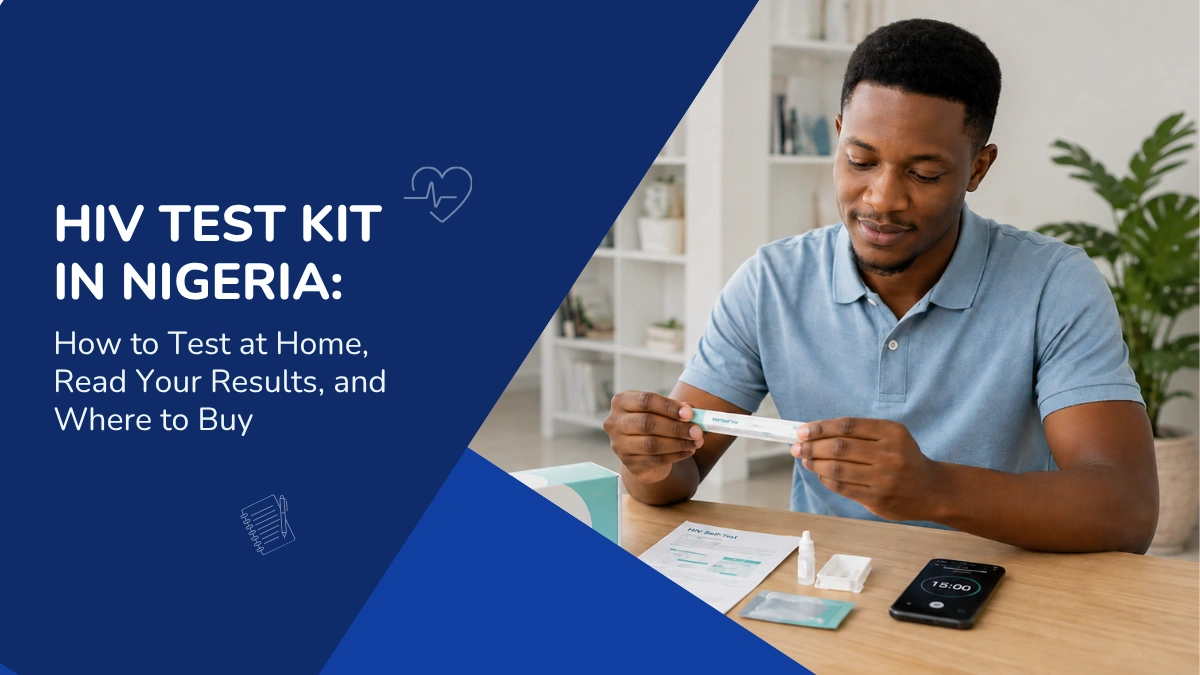
But that’s changing. With a personal HIV test kit, you can screen yourself at home, see the results within 20 minutes, and know where you stand before deciding your next step.
In this article, we’ll share how HIV testing works, how to use a self-test kit correctly, and what to do with your results.
An HIV test, also known as a serology test, is a screening test that looks out for antibodies, HIV antigens, or the virus itself, depending on the type of test used.
Note that the HIV screening test is not diagnostic and only points out the possibility of you having the virus. So, a positive screening test still needs further confirmatory and diagnostic tests, such as HIV NAT or HIV DNA PCR.
Yes. In most public testing centers, RVS (retroviral screen) is the standard term used when requesting or reporting an HIV screening test. Other names include HIV antibody test.
However, RVS is more often used to protect the requesting person’s privacy and minimize stigma associated with HIV.
Different HIV tests look for different factors that can suggest the presence of the virus in your body. Examples include:
These tests screen for the antibodies your immune system produces in response to HIV infection. Most rapid self-test kits, including finger-prick tests, fall into this category. Also note that antibody tests are fast and have a high degree of accuracy, but they may miss early infections, typically less than 4 weeks to 3 months.
The antigen-antibody test checks for the antibodies produced against HIV-1 and HIV-2 alongside p24 antigens as well. This combination results in accuracy exceeding 99% and can detect the virus as early as 18 to 45 days.
Fully called enzyme-linked immunosorbent assay, ELISA is a standard screening test, and modern fourth-generation ELISA tests detect both HIV antibodies and the p24 antigen, making them more sensitive than rapid antibody tests.
PCR (Polymerase chain reaction), also called a Viral load test, detects the actual virus in your blood rather than just the antibodies, unlike other tests. Since PCR focuses on the virus itself, the result is often more accurate and sensitive after 10 to 33 days of infection. However, PCR is much more expensive than antibody tests.
No. A CBC (complete blood count) only tells you the number and types of cells in your blood. That includes white blood cells, red blood cells, platelets, and their differentials. The result can reveal an ongoing infection but won’t tell you what’s causing the infection.
For instance, a high white cell count and anemia could mean active infection from bacteria or a virus. So, it is non-specific.
To find out your HIV status, you need HIV screening procedures, such as antibody tests.
Home HIV testing involves procuring a self-test kit, whether from a lab or pharmacy, and using it at home by yourself to check your HIV status. It is legal in Nigeria, and you do not need a prescription or a Doctor to get one.
Note that most basic home kits screen for HIV infection only.
However, some, like the Venchecker 4-in-1 Rapid Self-Test Kit, screen for HIV-1 and HIV-2, syphilis, hepatitis B, and hepatitis C, all from a drop of blood.
As a pharmacist-led health store, Lyfline Meds sources every kit for authenticity, and you can reach out for guidance on using it correctly. Order it for ₦9,000, delivered discreetly across Nigeria. Buy the Venchecker 4-in-1 Kit →
The benefit of a 4-in-1 kit is that syphilis and hepatitis share similar transmission routes with HIV. They can also present as co-infection. So, a single screening can reveal all at once and inform treatment decisions.
HIV self-test kits come with full instructions, which you should read before you begin the screening. In case there’s none, here’s the standard procedure you can follow.
Every rapid test kit’s cassette has two line positions. One is the control (C), and the other is the test position (T). This is how to read your test result based on these two line positions.
If only a single line appears and it is at the C position, that means the test did not detect HIV antibodies in your sample. Highly reassuring if you are past the window period. The Venchecker 4-in-1 kit has a result screen for each of the four infections, which shows the outcome of your testing simultaneously.
If two lines appear, one at C and the other at T, that means the test detected HIV antibodies in your sample. The T line might be faint or dark, but any line there counts as reactive. Note that a reactive result is not diagnostic and you still need to go to an accredited laboratory for confirmation as soon as possible.
An invalid result is when there is no line at C, regardless of whether there is a line at T or not. It means the test failed, possibly because the kit has expired, the buffer is not sufficient, the sample is not enough, or you didn’t handle the procedure properly.
The window period is the time between when you were exposed to HIV and when a test can detect it reliably. Any screening before the window period ends will produce a false negative result (negative even though you may have been infected).
Note that different tests have different window periods based on what they check for.
For instance, the window period for a rapid antibody test using the Venchecker Kit is 23 to 90 days after infection. On the other hand, PCRs and ELISA tests have a window period of 10 to 45 days, which means the test picks up HIV as early as 10 days.
A rapid antibody test at 2 weeks is unlikely to be accurate for most people. Your body might not have produced enough antibodies to trigger a positive result that early. That means a negative at 2 weeks does not mean you are clear. You need to retest at 6 weeks and again at 90 days.
Symptoms alone cannot diagnose HIV, and some HIV symptoms overlap with many other conditions. If you are past 90 days and your test is still negative but you remain concerned, see a doctor. You may need a PCR test or a more sensitive lab test to investigate further.
Go to a clinic or hospital urgently and ask about PEP (post-exposure prophylaxis). PEP is a short course of antiretroviral medication that can prevent HIV infection if started within 72 hours of exposure. A self-test kit is not the right first move in that situation.
A reactive screening result does not confirm that you have HIV. Many factors like recent vaccination, lab error, pregnancy, autoimmune conditions, and other viral infections can cause a false-positive result.
So, if your screening result is positive, you need to go to an accredited government or private laboratory center and ask for a confirmatory HIV test.
If the confirmatory test also comes back positive, you need to immediately see your Doctor for expert management, including starting an antiretroviral therapy (ART) earlier. Do not self-manage at home or delay treatment.
It is important to point out that a positive diagnostic result is not a death sentence. People diagnosed with HIV who start ART early and maintain a high CD4 count have a life expectancy roughly the same as that of the general population, according to a 2023 collaborative analysis of over 200,000 people across European and North American cohorts published in The Lancet HIV.
Free HIV testing is available at government health facilities, many primary healthcare centers, and NGO-run testing points across Nigeria. But free clinic testing comes with trade-offs. You may not have privacy, results take time, and a standard clinic test screens for HIV only.
A home kit costs around N4500 to N15,000 for a single-infection HIV kit. But you gain speed, privacy, and even more, multiple infection coverage with kits like Venchecker within 20 minutes.
The Venchecker 4-in-1 kit is available at Lyfline Meds for ₦9,000, with discreet delivery across Nigeria. Buy the Venchecker 4-in-1 Kit →
Single-infection HIV kits test for only HIV but do not screen for syphilis, hepatitis B, or hepatitis C, three common infections in Nigeria that are often asymptomatic in early stages. That means you have to get separate kits for them if you need to find out.
In contrast, the Venchecker 4-in-1 kit screens for all four infections from just one drop of blood and a single cassette. The results also come out in under 15 to 20 minutes.
The Venchecker 4-in-1 Kit from Lyfline Meds is available for discreet nationwide delivery at Lyfline Meds. Buy now for ₦9,000. Screen for four infections at home →
You no longer need a hospital or lab visit to know your HIV status. You can easily do that by getting an HIV test kit and handling the test yourself at home. Remember that a reactive result is not the final answer, and you still need to do a confirmatory test at a reliable lab for diagnosis.
If you are ready to screen, choose a kit that does more than one thing. The Venchecker 4-in-1 Kit from Lyfline Meds screens for four infections at once, discreetly, from home. Available for ₦9,000 with nationwide delivery. Screen for four infections at home →
This article is for general educational purposes only and does not constitute personalized medical advice. If you have a diagnosed condition, are on medication, or have had a recent high-risk exposure, speak with a licensed healthcare provider before acting on any screening result.